










Common mistakes when using orgonite pyramids and how to avoid them
When many people buy an orgonite pyramid for the first time, they make a series of mistakes that can reduce their satisfaction with their purchase or prevent the piece from fitting well into their space. This article explains the most common mistakes and gives you clear solutions to avoid them, in a practical and simple way. Before deciding where to place your pyramid or how to choose it, it is useful to know what not to do. This ensures that your investment will have the best results and that the piece will truly suit your needs and environment.

1. Choosing solely based on aesthetics without a clear intention
One of the most common mistakes is buying a pyramid solely because “it looks nice.” Although appearance is important, many people end up with a pyramid that does not fit their personal goal. For example:
Choose a large pyramid if the space where you want to put it is small.
Choosing a set of minerals that does not resonate with your everyday use
Buying a complex design without considering how it will look in your environment
How to avoid it: before buying, think about your purpose: Do you want it to harmonize your living room? Do you want an object that will accompany you in your moments of rest? Answering this will help you choose a pyramid that really fits your personal intention.
2. Place it in an impractical or inconvenient location.
Another common mistake is placing the pyramid in a location where it does not integrate with your daily use. For example:
Very high corners where you never see it
Spaces that are too small or very cluttered
Places where you it might get constantly hit
Place it away from sources of radiation in the home, such as Wi-Fi routers, where cell phones are left, tangled cables, computers, etc.
Placing it where you cannot see it makes it lose its visual presence and functionality, even if it is a good size and design.
Practical solution: place your pyramid in a location that:
Be at eye level or at least visible from where you spend most of your time
Do not obstruct the passageway or stand in areas where you could fall.
Be close to your daily activities (such as your living room table or desk).
3. To think that all pyramids are the same
Un error habitual es creer que todas las pirámides de orgonita son lo mismo. En realidad, hay diferencias importantes en:
Size and geometric proportion
Mineral composition
Resin quality and finish
Quantity and distribution of metals so that it really has an effect. Without metal, it is not orgonite.
These variations can change how the piece feels in your space and how you perceive it visually.
If you are unsure about what differences to consider, check out this resource:
How to select an orgonite pyramid based on your personal needs
4. Not considering the available space before purchasing
People often buy without measuring their space, and end up with a pyramid that is too large or too small for the location they had in mind. This happens especially when buying online without evaluating proportions or scales in relation to nearby furniture. How to avoid it: before buying:
Measure the surface where you want to place the pyramid.
Compare those measurements with the proportions of the product.
Consider visibility from different angles in the space.
5. Ignoring the quality of materials
Some pyramids that are sold very cheaply may look like orgonite, but they do not use genuine materials, do not include metal, or are made with low-quality resin. This causes:
The finish wears out faster
The piece looks dull before time
Some pieces use plastic fake imitation minerals.
The piece does not work because is lacking metals inside to be a proper orgonite.
This mistake can ruin the experience and integration into your environment.
Recommendation: always look for clear descriptions of the minerals and resin used. If you need more details on how to verify authenticity, check out this guide:
The finish wears out faster
The piece looks dull before time
Some pieces use plastic fake imitation minerals.
The piece does not work because is lacking metals inside to be a proper orgonite.
6. Placing the pyramid without considering the overall decoration.
People often think of the pyramid as if it were an isolated object, without thinking about how it fits in with the style of its surroundings. This can cause the pyramid to stand out in a way that is not harmonious or clash with the design of the room where you place it.
Solution: Look at the colors, textures, and furniture in your space before choosing the pyramid's design. Aligning it with your color palette and personal style makes it look natural and attractive.
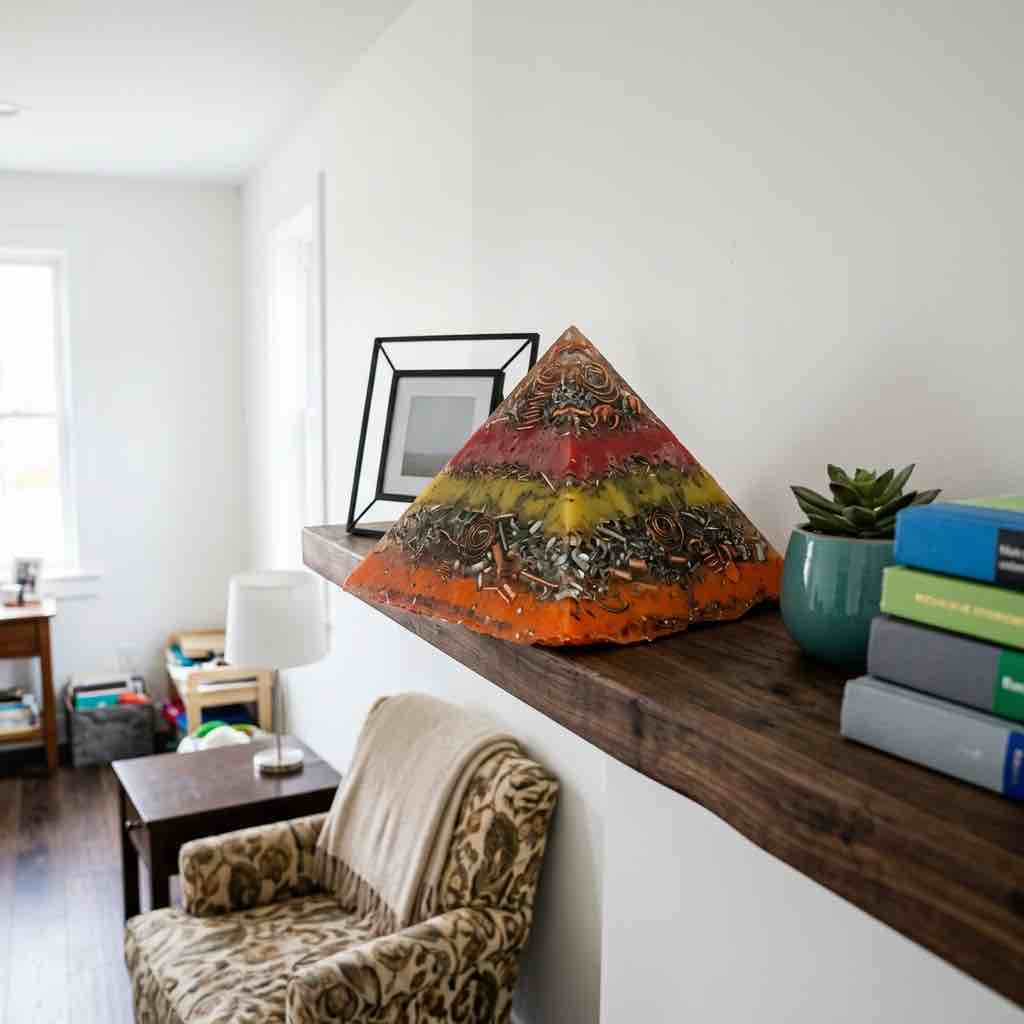
7. Not planning the layout when you have several pieces
If you have more than one pyramid, placing them in a disorderly manner can detract from their impact and create a feeling of saturation. For example:Several small pyramids stacked asymmetrically
Mixing them with too many objects without order.
Best practice: Create dedicated areas with a single pyramid or group pieces in a balanced way. Think about proportion, height, and visual proximity between them.
Frequently asked questions about errors when using orgonite pyramids Several small pyramids stacked asymmetrically
Mixing them with too many objects without order.
Is it bad to place a pyramid in the bathroom? Placing a pyramid in the bathroom is not “bad,” but consider the constant humidity and the possibility of it getting wet. Can I move it around frequently? Yes. Adjusting the location based on how you feel can be helpful in determining which place works best for you. Use your intuition. Do pyramids work the same if I place them in different rooms? This depends on how you perceive the visual and functional energy of the object in each space. There is no universal rule. If your goal is to protect the house from radiation, distributing a certain number of pieces throughout the rooms helps.
Conclusion
Avoiding common mistakes when choosing and placing an orgonite pyramid makes your experience with the piece more satisfying from day one.
The most frequent mistakes have to do with:
Choosing solely based on appearance without considering whether it works and is authentic orgonite filled with metal.
Not considering the actual space.
Ignoring the quality of the materials and its finish.
Placing them in non functional places
By correcting these practices, the pyramid will not only look better, but it will also integrate into your space in a more natural and meaningful way and, above all, it will do its job.
If you want to see tips on where it is best to place an orgonite pyramid, check out this specific article:
Clear recommendations on ideal positions for orgonite pyramids → /piramides-orgonita/donde-colocar/
And for ideas on how to decide which model to buy based on your needs, see:Complete guide to choosing an orgonite pyramid
Choosing solely based on appearance without considering whether it works and is authentic orgonite filled with metal.
Not considering the actual space.
Ignoring the quality of the materials and its finish.
Placing them in non functional places